
Seeing the System Behind Control
Recognize CREDA
Creda systems hide inside belief and belonging.
This page offers language and understanding to help you see what shapes, binds, and silences the self.
What is Creda?
Creda is a belief-based loyalty trap system. It doesn’t just control your behavior, it shapes your mind. It might look like purpose, healing, or community on the outside. But underneath, it uses fear, identity, and sacred meaning to keep you loyal, even when it hurts you. Not all Creda systems scream.
Some whisper.
Some wear smiles.
Some wear scripture.
Some wear success.
It begins with devotion, not force. People give themselves to something they believe is good, only to find that their freedom slowly contracts.
Creda is what bind belonging to fear and turns discretion into communal loyalty. It is unseen system of control, quiet, persuasive, and deeply human.
Suppress- The system quiets the authentic self. Doubt, individuality, and emotion are framed as weakness or rebellion.
Bind- Loyalty is rewarded. Members are kept close through shared identity, duty, and fear of loss.
Replace- Over time, the original self is replaced by the system’s version, compliant, certain, and dependent.
This is the cycle that transforms belief into control.
The L.O.C.K. Pattern
Creda systems keep people bound through a repeating emotional and behavioral cycle, a structure that limits awareness and rewards loyalty. Each phase feels different, yet all serve the same purpose: to preserve the system’s power.
Limit Information
Creates dependence by controlling what people know.
Redefines truth as whatever supports the system.
Encourages distrust of outside sources or independent thought.
Turns questioning into disloyalty.
Obedience as Worth
Equates compliance with goodness, faith, or virtue.
Makes approval conditional on following rules or leaders.
Uses guilt or shame to keep members aligned.
Discourages personal judgment or moral autonomy.
Control Identity
Rewrites self-concept to match the system’s ideals.
Limits freedom of emotion, dress, language, and relationships.
Encourages members to self-police and suppress individuality.
Rewards sameness over authenticity.
Keep Through Fear
Uses subtle or open threats, loss of belonging, reputation, or safety.
Frames leaving as betrayal, failure, or danger.
Keeps members busy, exhausted, or emotionally dependent.
Makes freedom seem unsafe or impossible.
Recognition begins when you see the pattern and remember that no system built on fear can define your worth.
The Loyalty Trap
The Loyalty Trap is the emotional and psychological system that keeps people inside Creda, even when something feels wrong. It begins with a pull, deepens through commitment, solidifies through roles and identity, and loops through emotional cycles, making it harder and harder to leave.
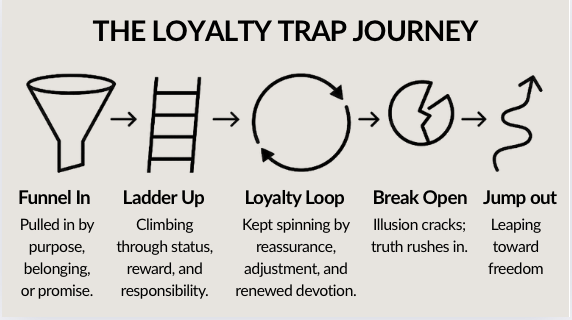
Every Creda system begins with belonging and ends with obedience. Loyalty becomes the invisible tether, the emotional bond that holds people even when logic says “leave.”
The more they sacrifice, the more meaning they attach. The trap deepens not through fear alone, but through devotion, the belief that staying is noble.
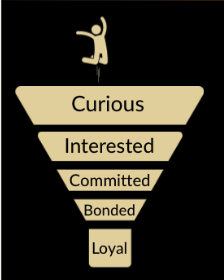
The Loyalty Funnel
The Loyalty Funnel describes how people move from simple curiosity into deep loyalty without ever intending to give up autonomy. It begins with interest, belonging, or meaning and gradually narrows into obligation, identity fusion, and fear of loss. Each stage feels reasonable on its own. Nothing looks extreme at first. The funnel works because it offers connection before it demands commitment, reassurance before control, and purpose before sacrifice. By the time loyalty is expected, the cost of leaving feels greater than the cost of staying. What began as choice slowly becomes a psychological trap.
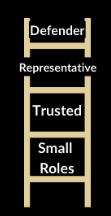
The Loyalty Ladder
The Loyalty Ladder shows how commitment intensifies step by step, often without conscious awareness. Each rung represents a small increase in expectation, responsibility, or self-sacrifice that feels reasonable in the moment. The climb is gradual, built on prior choices, emotional investment, and the desire to remain consistent with who one has already become. Because no single step feels extreme, the overall shift is easy to miss. Over time, the person is no longer choosing freely but responding to accumulated pressure, identity attachment, and the fear of losing what has already been given.
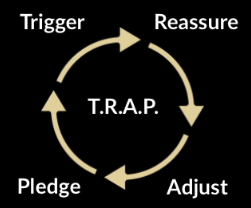
The Loyalty Loop
The Loyalty Loop reveals how loyalty is reinforced and sustained once a person is already inside a system. Moments of doubt, discomfort, or conflict are met with reassurance, correction, or emotional pressure that redirects the person back into alignment. Relief follows compliance, strengthening the belief that staying loyal brings safety, belonging, or peace. Over time, this cycle trains the person to self-correct, suppress doubt, and renew commitment without external force. The loop keeps loyalty active not through constant control, but through repetition, emotional conditioning, and the fear of disruption.

The Break and The Jump
The Break and the Jump mark the moment when loyalty fractures and forward movement becomes possible. The break is internal, when doubt is no longer suppressed and the cost of staying becomes visible. The jump is external, choosing to step away without certainty of what comes next. This stage is often accompanied by fear, grief, and disorientation, because identity, belonging, and safety were once tied to the system. Leaving is not a clean exit but a rupture, and freedom begins not with clarity, but with the willingness to move despite the unknown.
The Loyalty Funnel
A slow slide into emotional entrapment.
Curious – Something sparks interest. It feels new, promising, or different.
Interested – You want to know more. Messages feel relevant or hopeful.
Committed – You invest time, energy, or emotion. The system feels good or right.
Bonded – You form ties, relationships, belonging, purpose.
Loyalty – You defend it. You see it as part of you. Leaving feels like betrayal.
The Loyalty Ladder
As trust grows, your role increases.
Small Roles – Simple tasks. Easy participation.
Trusted – You’re seen as reliable. Given more responsibility.
Representative – You speak for the group. Others look to you.
Defender – You guard the group’s values. You correct others. You protect the system.
The Loyalty Loop
T.R.A.P. Even when doubts arise, this cycle pulls you back in.
T = Trigger – Something feels off. A moment of doubt, hurt, or discomfort.
R = Reassure – The group comforts you. Explains it away. Blames your weakness.
A = Adjust – You shift. Lower expectations. Reframe the problem.
P = Pledge – You recommit, often harder. You double down to stay “good.”
This loop can repeat endlessly, each time making it harder to break free.
The Break + The Jump
Eventually, something snaps.
The Break – A moment of clarity, pain, or disillusionment. You see it clearly.
The Jump – The hard leap out. Risky. Lonely. But it’s the first step to freedom.
Every trap ends the moment awareness outweighs fear. The jump is small, but it changes everything.
Freedom is the quiet courage to think, feel, and choose again.
Healing is the moment control loosens and your own voice returns.
Humans Needs
Creda explores how loyalty and belief can become invisible systems of control. It helps readers recognize the psychological patterns behind manipulation, and reclaim their freedom of thought.
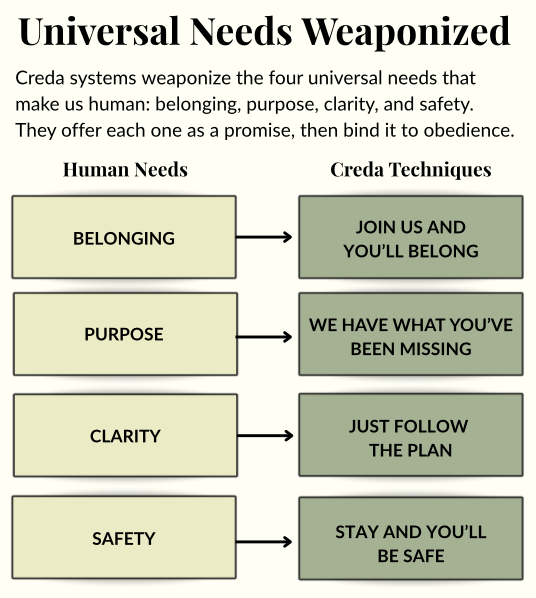
Belonging, the desire to be seen and accepted, is reshaped into conditional inclusion: You belong as long as you agree.
Purpose, the need to live with direction and contribution, becomes service to the system’s mission: Your value is measured by how well you serve the cause.
Clarity, the longing for understanding and order, turns into rigid certainty: Do not question; truth has already been decided.
Safety, the need for stability and protection, becomes justification for control: Obey, and you’ll be protected.
These four needs shape every human life. When a system controls them, it controls the person.
Each need is real, but under Creda, it’s redirected. What once fostered freedom now enforces loyalty. The structure feels secure at first, even comforting, but it quietly drains individuality. Over time, the gifts that make us human become the chains that hold us in place.
The antidote to control begins with awareness.
Recognition is the first act of freedom.
Once you can name what shapes you, it begins to lose power.
If you’d like to learn more, you can subscribe to my free newsletter for weekly reflections, or explore the Red Flag Checklist to begin recognizing patterns of control.